Showing posts with label religion. Show all posts

Thursday, May 1, 2025

#78. My Thinking on Evolutionary Psychology: Summary to Date

EP


Red, theory; black, fact


Darwin's first diagram of evolution


The behavioral innovations occurring in the evolutionary sequence leading to ourselves may have been, in chronological order:

  • H. habilis tool manufacturing and gender roles.
  • H. erectus: systemic refugee production, dispersal, ethnicity, and language.
  • Early H. sapiens: warfare, shelter building, and tricksterism.
  • Late H. sapiens: siege resistance and religion.

General hypotheses: 1) The earlier the innovation, the less modifiable it will be; 2) The dominant neuromodulators that organize the innovations emerging post-H. habilis will be noradrenalin (primordial organizer of responses to intraspecific competition) and serotonin (primordial organizer of responses to predation). 3)  Siege resistance is the adaptive form of the corresponding failure mode siege mentality.

Picture credit: Wiki Commons

Thursday, February 20, 2025

#75. The Broad Context of Religion [evolutionary psychology]


Red, theory; black, fact


[Quotes indicate metaphor.]
  • Organized religion may have arisen as a counter-adaptation to the anti-invasion adaptations  of a neighbouring, powerful country that included sorties.  For the Abrahamic religions, that powerful but geographically vulnerable country would be ancient Egypt. For the Eastern religions, the powerful but vulnerable neighbor would be ancient China.
  • People are "amphibians": each of us has a collectivist part existing in genetic superposition with an individualistic part. In systems that officially celebrate the former, the latter cannot be owned and must be pushed into the Jungian Shadow. And vice versa. In Freudian terms, the unacceptable wishes emerge in disguised form: religion in individual-celebrating systems, and hero worship in collective-celebrating systems.
  • The longstanding debate in philosophy between rationalism and empiricism is a false dichotomy resulting from a narrow focus on one or the other of the two legs by which scientific knowledge advances: theory and experiment.
  • If religion is the last protoscience, then the corresponding science that is to come could be called security science. 
  • The incredible disunity of Protestantism could mean that Protestantism is the laboratory of Christianity.
  • The crucial step in going from a protoscience to a science appears not to have been experimentation, but quantification. Examples of early quantifiers were Tycho Brae (astronomy) and Antoine Lavoisier (chemistry). If religion is a protoscience, what would its quantification look like? “Reminder: It’s time to bring up your prayer checklist, tick the boxes that apply under each heading (Adoration, Confession, Thanksgiving, and Supplication), and upload it to the diocesan office. The results of statistical analysis will be announced at Vestry, at which time parishioners may suggest further research questions. This activity parallels and does not replace traditional prayer. All submissions are protected by best-practice data security.
  • The first step in graduating to security science may be compiling a glossary of religious terms and their non-supernatural, parallel interpretations. For example, the Jewish ban on eating pork can be interpreted in this spirit as a measure to prevent trichinosis (a disease transmitted by eating under-cooked pork or wild game). As another example, the four prayer headings enumerated above could be identified in terms of a longitudinal study as control, exposure, favourable outcomes at followup, and adverse outcomes at followup. As a third example, the three persons of the Trinity could map onto the three sources of security science: study of the individual, the society, and the evolutionary history of both (Son, Holy spirit, and Father, respectively).
  • Science has to be for everyone.
  • We don't have free will in the big things; we have free will in the little things. However, one of the little things can be "planting a seed" that may one day grow into one of those big things and be more to our liking than the big things we see now.
  • Should security science take on the task of predicting the unintended consequences of innovations, or is that task so large as to require another new science?

  • On the answers to the big questions, the sources of authority are the size of the database and the degree of regulation of the original inquiry. Writing things down would be one rule of inquiry; using a set process would be another; making well-defined measurements would be another; the experiment form would be yet another. The degree-of-regulation parameter takes us smoothly from protoscience to hard science via the qualitative study, which has legitimacy today.

Thursday, May 23, 2019

#51. Advanced Human Depopulation Model [population, evolutionary psychology]

PO   EP

Red, theory; black, fact

Picture 1: A four-stage model of a human depopulation event. C = cycle; growth = growth phase; depop = depopulation

Picture 1 shows a four-stage model of human depopulation events that is intended to account for more data than heretofore. The same two emotional programs, the anger cycle and the sadness cycle occur in two "generations," with the second generation having greater violence and using modified signals.
  • Stage 1: depopulation by emigration; accomplishes dispersal of the human species; coordinated by an exchange of anger signals;
  • Stages 2-4: depopulation by mass murder: accomplishes long-term population density confinement within limits;
  • Stage 2: coordinated by an asymmetric exchange of contempt and sadness signals; has similarities with cannibalism;
  • Stage 3: total war program; coordinated by an exchange of anger signals with mimicry added;
  • Stage 4: loss of civilization; triggered by a repudiation of the social contract by trusted elites with grudges: coordinated by increasing paralysis on the part of victims and increasing cynicism on the part of perpetrators. May be too recent an evolutionary development to have an efficient halting signal.

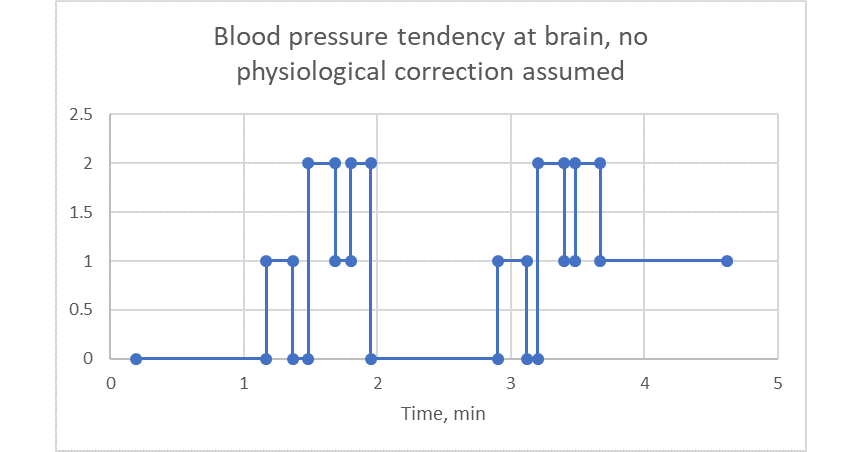
Nevertheless, the modes of worship of Islam are the best place to look for such a signal or other remedy if it exists. In this connection, the Islamic prayer discipline has potential to alter brain physiology, based on variations in blood flow to this organ, known to be highly sensitive to same. The variations would come about as a result of the highly regimented posture changes occurring during Islamic prayer. I have coded these postures according to the probable effect on blood pressure measured at the brain, and the result looks like this:

Picture 2. The inferred brain physiology of Islamic prayer. Source of data: YouTube, "Time to pray with Zacky," accessed 05-23-2019.

 Shown are my inferred variations in brain oxygenation during two rakat, or units of prayer. Bowing is coded the same as sitting, namely 1. Prostration is coded as 2 and standing is coded as 0. Some forms of Islam prescribe up to 19 rakat per day. Special procedures (Sujud Sahwi) exist for fixing prayers performed erroneously due to "forgetfulness" but this "forgetfulness" I find suggestive of temporary brain dysfunction due to lack of oxygen from getting up too quickly, possibly at about minute 2, above.
The above observation is to help establish that Islamic prayer manipulates a variable that matters, always an important issue at the outset of a research project. You don't want to waste taxpayer money blindly researching variable after variable and concluding at great expense merely that none of them was relevant.


Saturday, March 16, 2019

#50. A Theory of Christianity [evolutionary psychology, population]

PO    EP

Red, theory; black, fact


Continuing from Post #49, doubts about the completeness of my assessment began with this statement by Saint Paul:

“And if Christ be not risen, then is our preaching vain, and your faith is also vain.”

1 Corinthians 15:14, KJV

I was struck by the clarity and insistence of this impossible claim. What is going on here? We as theoreticians need to drill down here.

“Risen” means having come back from the dead, which is still an impossibility for modern medicine. However, Paul explains that what dies is a “natural body,” whereas what rises, or is “resurrected,” is a “spirit body,” which is “incorruptible.” The word resurrection does not appear in the Old Testament (Hebrew Bible), making its first appearance in Matthew, the first book of the New Testament. All things considered, the concept is obviously central to Christianity.

Postulate 1: Resurrection theology is an approximate theory, and as such, is allowed to contain an impossibility.

An Alternative Theory 

The old, skeptical explanation of the resurrection, namely that the crucifixion was a fraud, deserves mention here. The New Testament mentions particular Romans and Pharisees sympathetic to Jesus. Extrapolating, I posit a pro-Jesus faction spanning all segments of that society and including many influential Romans and Pharisees, who would have had the resources necessary to pull off such a deception, but who could not openly interdict the crucifixion for lack of the necessary influence. Thus, the seeming miraculousness of the resurrection would in reality be a measure of the power of the illusion that groups identified as “The Enemy” are implacable and unitary.

Postulate 2: Christianity is focused on taming a third stage of depopulation that follows the anger cycle and the sadness cycle if neither of these has returned population density to the reset value after a certain time. 

An Evolutionary Interpretation 

This third stage is the total war stage, and it takes place on an international scale. Examples are WWI and WWII, which would be the international phases of national conflicts between a central-European majority and Serbs and Jews, respectively. Total war is arguably altruistic because each of two alliances or countries is helping the other with their population problem. The required signaling cycle seems to be that of the anger cycle but with the exchanged signals doing double duty as liquidation tactics. This is not just a fight, where the only consideration is what would be the shrewdest blow; there is a strong tendency to ape the opponent’s latest gambit, as expected in an exchange of signals "designed" to lock non-altruists out of the process. This psychology is called “sending back the bullet” in battlefield situations and “poetic justice” in everyday life. It is satisfying and it is a signal and it is illegal in peacetime, no matter that the other guy started it. In peacetime, you have to search elsewhere for your solutions than in mimicry and cooperation with a dangerous emotional program. Furthermore, if you allow yourself to be drawn into a vendetta, you just wrote an “ = “ between yourself and the person you take exception to. 

The total war program is well known for its destructiveness to the infrastructures of civilization, which suggests that the program evolved recently and is still being refined by natural selection. It may not even be older than agriculture, the last quantum leap in our ability to increase our numbers. That new ability may have generated the selection forces that brought forth the total war program.

Christian theology works a rational override on the anger cycle by reassuring believers that they will be resurrected and therefore need not fear death. Since anger is fear in disguise, this reassurance undercuts the anger-cycle-like dynamics of the total war program.

Postulate 3: the corresponding exact theory of Christianity is that depopulation events always leave survivors and Christianity enhances your probability of being one of them. When population density has declined to the reset value, this should trigger a dramatic turnaround in the Zeitgeist from death-producing attitudes to nurturing ones, to start the population-density curve on its next long, slow upward climb. The resurrection of “spirit bodies” may refer to the re-establishment of life-valuing attitudes in society.

It follows that the human race is being selected for a predisposition to Christianity, and probably other religions as well.

The book of Revelation, the last book in the New Testament, appears to describe the sudden depopulation event that ends the population-density cycle. This is identified as the end of time/history, but remember that we deal here with an approximate theory.

Practices

Christian worship activities revolve around the Eucharist, a communal sharing and consumption of bread and wine. Its purpose is to eradicate the deepest roots of the fear of death, a fear that leads to the hatreds of the total-war emotional program. How does it work?

The Eucharist pacifies people by exposing them to the halting signal of the total war program. So, it halts. How did the consumption of bread and wine come to be the halting signal? Because they are made by people playing with their food, maybe for the sake of variety. However, this comes at the cost of caloric content (not caloric density) because the yeast always takes its cut. This practice will only make sense under conditions of plenty, which return with sufficient depopulation. Thus, alcohol, which I assume to be the active signaling ingredient, and leavened bread now signal to the human limbic system the return of abundance. I conjecture that these signals have a subtle pacifying effect, making it easier to resist tit-for-tat total-war signaling.

Alternatively, Jesus may have been medicating the disciples with food and alcohol to keep their arousal level out of the panic zone at a time of peak emotion so that they could continue to function adaptively.

Wednesday, February 27, 2019

#49. A Naturalistic Theory of Worship [evolutionary psychology, population]

 PO    EP

Red, theory; black, fact

Anytown, Canada, Apr. 11

Religion has a theory part and an applied part. The latter are the modes of worship. Since our moral codes are held by at least the Abrahamic religions to be commands from God, it would follow that it’s pretty important to conform to them, and most of us have difficulty doing this all the time. To help us, religion has developed a behavior-modification role, the role of the modes of worship.

The behavior-mod role aims at mitigating the human form of the Calhoun Effect—a tendency to aggression linked to rising population density but not to actual want per se. See post #36. Population density would have been an issue even millennia in the past when the world population was a minuscule fraction of what it is today, when people began living continuously inside walled cities for protection from their enemies. Within the inflexible confines of such a city, you have the makings of a human Calhoun experiment. Not coincidentally, the city of Jerusalem, sacred to three world religions, was a walled city. Nowadays, at a world population of 7.5 billion, it can be said that the world is our walled city. What can religion now tell us about how to get along?

Jerusalem in 1972
I’ll focus on the Abrahamic religions: Judaism, Christianity, and Islam, which developed in that order, all in the Middle East, each of the last two acknowledging its debt to the previous. I suggest that these three religions form a series of progressively increasing effectiveness in mitigating the Calhoun Effect, by an accumulation of folkloric knowledge. Thus, to see how modes of worship work, the purpose of this post, we need only examine Islam, likely to represent the most efficient solution. Form generally follows function most transparently at highest efficiency.

The Human Calhoun Effect

The natural human population density plot over time has a saw-tooth form, with linear increases alternating with abrupt decreases that return population density to some repeatable reset value. The linear segments are created by a negative-feedback controller in the limbic system that controls rate-of-change of population density to a constant positive value, not absolute density. At this writing, the world is probably coming to the crest of one of these linear segments, which began in 1950. The sudden population-density decrease that ends the cycle may have two phases: a first that produces population-density decrease by emigration, and a second that produces population-density decrease by mass murder, if the first phase does not take the system all the way to the reset value. The first phase accomplishes the biological function of dispersal, which is generally important for long-term species survival. The second guarantees overall stability on a multi-cycle time scale and wards off Malthusian catastrophes.

Both phases demand formally altruistic acts from individuals, but not of the warm-and-fuzzy kind. The first phase uses an exchange of anger signals to lock non-altruists out of the process so that the behaviour is stable over evolutionary time. The second phase locks out the non-altruists using an asymmetric exchange of signals: contempt signals going one way and sadness signals going the other way. The second phase culminates in the mass murder of the sadness signalers by the contempt signalers and the appropriation of all the resources of the sadness signalers by the contempt signalers. The last step guarantees that the contempt signalers will appear entitled to those outside the cycle.

Islam

Islam is conveniently summarized for our purposes as The Five Pillars of Islam, which are explained in the Quran, namely:
1) The Creed. 
(“There is no God but Allah, and Muhammad is the messenger of Allah.”)
2) Prayer.
3) Charity. 
(Concealed almsgiving is preferred.)
4) Fasting.
5) Pilgrimage.

The Theory

The creed is “The Great Why in the Sky” that people need for the control of their most difficult emotions. Strong emotion can be overridden by reason if that is required by a learned worldview, the validity of which the person is willing to bet their life on. Here, I attempt to supply a worldview based on evolutionary psychology. The creed, or “theory part” of a religion, also gets the rational mind cooperating with the behaviour-modification program, which acts on the emotional self. 

Rational override based on some creed may begin the work of extirpating someone's anger or sadness cycle, but behaviour modification may be necessary to finish it and produce a lasting improvement in the person's circumstances. These cycles may have deep roots inaccessible to consciousness and capable of perpetuating self-defeating behaviors if not treated appropriately.

Prayer superficially is a deliberate wasting of time, which is not free in metabolic terms because the worshipper has a basal metabolic rate that must be supplied whether he/she works or not. Regular inactivity is surely a luxury of only those enjoying abundance. This is implicitly saying to the anger and sadness/contempt programs: “Food is still plentiful, so it’s not time to get nasty.” These cycles may be triggered by signs of high population density, not actual want, but they should still be sensitive to metabolic signals that speak to whether actual scarcity exists. High population density acquired its potent psychological effects, after all, because it usually predicted scarcity in the environment of evolutionary adaptedness. Alternatively, prayer may work like meditation to turn off the internal voice and the unnecessary stress it causes if unscripted.

Charity, on the receiving end, that is, is for contempt signalers, who, as you will recall, are extremely entitled in the final stage of their emotional program. Accepting charity–goods that you did not work for–tells the contempt program that it has achieved its mission and can therefore halt. So, it does. In Islam, almsgiving is said to be best done in secret, an effect of which will be to spare the pride of the recipient. This will be an issue with contemptuous types.

Fasting–going without the necessities of life–is for sadness signalers and it tells their emotional program that they have given or lost all their resources to the contempt signalers, and therefore their program has achieved its mission and can halt. So, it does. On the other hand, based on my own experience with fasting, the practice may work by increasing the faster's energy level post-fast, and an increased energy level can solve a multitude of problems.

Pilgrimage is where you tell the anger-cycle program with your feet that you have been driven out of your homeland forever and must resettle elsewhere. Therefore, the program has achieved its mission and can halt. So, it does. 

Thus, the task of much religious behavior-modification can be likened to persuading a devil to depart by showing him false evidence that he has accomplished his purpose in coming, knowing that he is myopic. However, prayer tells him that he doesn’t even have to come in the first place.

Monday, December 31, 2018

#47. Science and Proto-science [evolutionary psychology]


Red, theory; black, fact

Is protoscience fundamentally playful?


Why does religion continue to be so popular in today's supposedly enlightened age? In what category of things should we place religion for purposes of analysis? The least bad answer that I have come up with is: "Religion is the last protoscience."

Protoscience is most easily defined by a few well-known examples: alchemy and astrology. These disciplines can be thought of as crude, primordial versions of chemistry and astronomy, respectively, and unable to quickly divest themselves of bad theories due to an over-reliance on aesthetics as a way to truth.

If religion is a protoscience, that then, is the corresponding science? Will religion someday transform into some kind of super-science, marvelous beyond all prior imagining, and capable of robustly duplicating all the miracles of Christ, just for starters?

The science that could replace the protoscience religion is likely to be the study of adaptive, distributed, and unconscious behavioural effects in human populations. This will be a division within sociobiology focused on human swarm intelligence acting on an historical time scale. From my own examined experience, I have reason to believe that such things exist. 

Historical Protosciences

Alchemy is thought to have become chemistry with the isolation of oxygen in pure form by Priestly, which was quickly followed by its recognition as an element by Lavoisier, who had met Priestly in Paris and learned of the new "air" direct from the discoverer. This clue led Lavoisier to a correct theory of the nature of combustion. Priestly published his discovery of oxygen (Lavoisier's term), which he called "dephlogisticated air" (an alchemical term), in letter form, in 1775.

The corresponding intellectual hand-off from astrology to astronomy seems to have been from Tycho Brae (1546-1601), who seems to have been much involved with astrology, to his assistant Johannes Kepler (1571-1630; "The Legislator of the Heavens"), who derived three famous mathematical laws of planetary motion from Brae's data.

Where Are They Now?

While the former astrology continues to this day as basically a form of amusement, and the former alchemy has utterly perished (as theory, not practice), religion continues to pay its way down the time stream as a purveyor of a useful approximate theory.

The Longevity of Religion

An approximate theory is useful to have if all you need is a quick and dirty answer. The theory that the Earth is flat is an approximate theory that we use every time we take a step. The corresponding exact theory, that the Earth is spherical and gravitating, is only needed for challenging projects such as travelling to the moon.

The God Hypothesis

Thus, the God hypothesis is the theory of natural selection seen "through a glass darkly." However, the experiences contributing to the formulation of the God hypothesis would have been due to any cause of seemingly miraculous events over the horizon or beyond the reach of individual memory. This would comprise a mixture of the fastest effects of evolution and the slowest effects of synaptic plasticity/learning (e.g., developmental sensitive periods). However, the capacity for learning is itself due to natural selection and learning is, like natural selection, a trial-and-error process. Thus, the two sources of biological order hinting at the existence of God should usually be pulling in the same direction but perhaps with different levels of detail. Modern skepticism about religion seems to be directed at the intellectual anchor point: the God hypothesis. Since I believe that they are best de-faithed who are least de-faithed, let us simply shift the anchor to natural selection and carry on.

Future Directions

I think it premature to abandon classical religion as a source of moral guidance before evolutionary psychology is better developed, and given the usefulness of approximate theories, complete abandonment may never be practical. However, in our day, humanity is beset with many pressing problems, and although atheism appears to be in the ascendent, it may be time to integrate religion with science so as not to throw out any babies with the bathwater.

The Practices May Outlive the Protoscience

The modes of worship in use in many modern religions may well confer psychological benefits on the pious not yet suspected or articulated by mainstream science. Scientific investigation of the modes of worship that many religions have in common seems in order, especially since they amount to folk wisdom, which is sometimes on the money. Examples of common practices that seem to have potential for inducing neurophysiological changes are prayer, fasting, pilgrimage, incense-burning, and even simple congregating.

Photo by JJ Jordan on Unsplash

Sunday, November 18, 2018

#43. Sunshine in Covey's Gap [evolutionary psychology, neuroscience]

EP   NE

Red, theory; black, fact


It is difficult to make a disagreeable emotion go away before one weakens and act it out, to their detriment. Techniques of true emotional control, i.e., making the bad feelings disappear rather than white-knuckle, open-ended resistance to acting them out, are not impossible, just non obvious. You just have to persuade yourself that this bad is good and believe it.

For the modern person, that second part, the believing, is difficult to achieve robustly if one is using religious solutions to the problem, the domain of soteriology (being "saved"), easier with psychoanalytical solutions, and easiest of all with scientific solutions. "Believing," here means being prepared to bet your life on the truth of a proposition.

Steven Covey writes in "The Seven Habits of Highly Effective People" that between stimulus and [emotional] response, humans have a gap in the causal chain and animals do not. In the gap are  imagination, self-awareness, conscience, and self will. George Santayana seems to have grasped this truth when he wrote: "Our dignity is not in what we do but in what we understand. The whole world is doing things." [source, Wiki quotes, accessed 11-06-2018]

Neuroscientist Joseph LeDoux has elucidated what could be the neural pathways that make Covey's gap possible. A direct pathway from the thalamus to the amygdala mediates the basic fear response, but an indirect pathway that leads from the thalamus up to the cerebral cortex and then down to the amygdala provides a more nuanced, intelligent amendment to the first response. Full cancellation of the direct pathway by the indirect would account for Covey's gap, and this could be done by a cortical relay through the inhibitory interstitial neurons of the amygdala that terminate on the amygdalar projection cells.

The doctrines of classical religion probably lead to such cancellation of emotions such as hate and fear by activating the same circuits that are used by a parent to reassure a needlessly fearful infant.

Apparently, classical religion is about getting people to do the right things for the wrong reasons. When the discipline of evolutionary psychology is sufficiently developed, we can look forward to the age when people do the right things for the right reasons.

Friday, September 7, 2018

#42. A Discovery of Hackers [population, evolutionary psychology]

PO   EP

Red, theory; black, fact


The hacker phenomenon may be psychologically and sociologically akin to what was once called witchcraft, and I think witchcraft is a scientifically accessible social phenomenon. 

The Past

However, the height of the witchcraft hysteria in Europe occurred during the Sixteenth century, when there were no computers. (I focus on Europe here because my ancestors came from there as did those of most people I know.) It was, however, a time of unprecedented scientific advance, and if science paced technology then as now, quite a few new technologies were coming into knowledge for the first time.

The Future

I suggest that the defining toxic ingredient in black-hat hacking is new technology per se. We should therefore expect that with time, computer hacking will spread to new-technology hacking in general and that the computer-centric version must be considered the embryonic form. This is bad news because there has never been so much new technology as now, but at what point in history has this not been true?

The Mystery of Witch Hysteria

Belief in and persecution of witches is so widespread across human cultures that it must be considered a cultural universal. Scholars focus on the persecution part, blithely assuming that there is absolutely nothing real driving it, and that the subject people of the study are, by implication, gullible and cruel. Is this stance elitist? Never judge a man until you have walked a mile in his shoes. Those people all have brains in their heads built to the exact same design as our own, and the role of education may be overrated when cultural universals are in play.

A Contemporary Interpretation 

The defining idea of the witches/technology hackers may be viewing new technology as a possible means to increase personal power. After siege mentality sets in, fear of apprehension and punishment leads to a mad-dog rejection of all morality, like a gambler chasing the money, or in this case, the indemnity. 

A Contemporary Interpretation of Black Magic

A technology ideal for hacking/witchcraft must be usable without the identity of the agent coming into general knowledge, and is thus  similar to the ring of Gyges mentioned in Plato's Republic. The anonymity conferred by the Internet makes it one of our worst rings of Gyges.  More will be discovered in other realms of technology as the hackers branch out, perhaps in alliance with the currently popular Maker movement. 

How common are Gygean technologies? Hard to say, but it may help to list some.
  • Ionizing radiation was known from the work of Roentgen in 1895 (x-rays) and Villard in 1900 (gamma rays) and for the first time, a means to destroy healthy, living tissue silently and through walls solid enough to conceal all signs of the agent, had become available. 
  • The lead pencil, introduced in the Sixteenth century already alluded to, was originally made with actual lead metal instead of graphite and clay mixtures, which we now know to be insidiously neurotoxic, especially to children--knowledge to warm the heart of any proper witch.
  • In the time of Christ in the Middle East, the Roman occupiers knew of ten or so plant-derived poisons, including opium. The very concept of a poison could have been new in those days, and poisons are the classical hard-to-detect weapons. If the weapon is hard to detect, so is the agent. A crypto-technological explanation for some of the events of the New Testament seems possible.
Gygean weapons are doubly "invisible" when based on new technology because these modus operandi are not yet on anybody's radar, so the first x number of people who spot them are likely to be disbelieved and their sanity questioned.

Witches have always operated in the zone of perceptual blindness to abuses that transiently opens up after the introduction of any new technology. The psychological invisibility of weapons based on new technology is probably the factor that led witches to become associated with magic. 

Psychological Aspects 

Moreover, since the technology is unprecedented in human evolution, the levels of resentment that become inducible in the victims are potentially unprecedented and unphysiologically intense, leading to grotesquely disproportionate punishments being meted out to discovered witches, and this for strings of crimes that would have been extremely serious even considering strictly proportionate punishments. The historical accounts of witch-burnings may have all been cleaned up for a squeamish readership.

Why were a majority of European accused witches female? It is probably relevant that the female-specific scold’s bridle was in use at this time. At the height of the anti-witch hysteria, the Catholic Church was pushing back against the Protestant Reformation, and yet Catholicism was relatively tolerant of witchcraft. The most witch trials per capita were in high-latitude or high-altitude countries (e.g., Norway, Scotland, Switzerland) that would have been most affected by the  “little ice age” of the 1600s. Other crimes like theft and murder surged when witchcraft did. I’m not sure what all this adds up to beyond a society under stress.

The Present

Today, the hackers are mostly male and the demographic challenge is too many people, not too few. Calhoun's overpopulation experiments on rodents imply that people will become more aggressive if forced to live at higher population densities, and such a relentless increase in aggressiveness may be driving the current reemergence of the witch/hacker. 

It doesn't help that organized religion, the traditional enemy of witchcraft, is withering on the vine in this country, probably due to the intellectual fallout from Darwin's theory of evolution combined with the failure of the public to understand that a scientific world-view is never finished and may some day substantially validate the claims of religion after some reinterpretation of terms.

Wednesday, April 4, 2018

#37. The Fallacy of Justice [evolutionary psychology]


Red, theory; black, fact


The Biology of Badness

Evil and criminality may sub-serve either dispersal or preemptive population reduction, both valuable biological processes that tend to prolong the survival of species. 

The algorithms for achieving these ends would have been created over time by some form of evolution.

Evolution and the Role of Emotion

The genetically inherited parts of our behavior enter consciousness as emotions, and can therefore be easily identified. The main outlines of civilization are probably due to the inherited behavior component, and not to the reasoning, conscious mind, which is often just a detail-handler. How could civilization rest on a process that can't even remember what happened last weekend?

Thus, humans have a dual input to behavior, emotion and reason. The above arguments show that evil and criminality come from the emotional input. Yet the entire deterrence theory of justice assumes the opposite, by giving the person a logical choice: "You do this, we do that, and you won't like it. So you don't do this, right?"

However, I think that people commit crimes for emotional reasons. As usual, the criminal's reasoning faculties are just an after-the-decision detail handler. The direction that this detail handler then takes is fascinatingly monstrous, but this does not mean that crime begins in reason.

Conclusion: the deterrence theory of justice is based on a category error.

Past and Future Responses to Badness

Religion, with its emphasis on emotion, was all the formal "law enforcement system" anyone needed up until only about 200 years ago, at the industrial revolution. We may be able to go beyond where religion takes us by means of a disease model of criminality.

It does make some sense to lock criminals up, because with less freedom they cannot physically commit as many crimes. Many prisons become dungeons, however, because of the public's desire for revenge. However, all revenge-seeking belongs to the dispersal/depopulation dynamic and is thus part of the problem. A desire for revenge may follow a crime very predictably, but logically, it is a non-sequitur.

A more nuanced theory of crime prevention is possible, where logical and technological constraints on behavior complement efforts to reduce the motivation for committing crimes at the source: the individual's perception of the fairness of society, which will be due to a combination of objective realities and the filters through which they are viewed. However, I originally wrote as I did because I don't think that logical and technological constraints are the squeaky wheel at the moment.

Thursday, February 1, 2018

#35. The Thought Process Through the Ages [evolutionary psychology]


Red, theory; black, fact


In the beginning, there was theology. At some point, intellectual endeavor split into wrestling with reality questions vs. morality questions. Then people had to figure out when to go with your gut and when not to.

_________________

Thought sources

Inputs

Output insights

Reality (What is)

Blend

Morality (Thus…)

PGSd+senses

Emotion

politicsc

religionc

Blend

astrologyb 

theologya 

Jewish lawb 

Education+senses

Reason

sciencec

lawc

a. primordial condition
b. output distinction added
c. input distinction added
d. evolution; see post 22

If politics and science seem like strange bedfellows, consider that ancient rulers used to consult astrologers before making major decisions.

Just as emotion must not be allowed to contaminate scientific thought, is it equally true that reason must not be allowed to contaminate religious thought? Is failure to observe this restriction the cause of religious schisms?

Tuesday, December 26, 2017

#34. The Pilgrim and the Whale [evolutionary psychology]


Red, theory; black, fact

The Cabot Trail, where you might see a whale

Just as the whale must hold its breath to obtain its food from the sea, so must a human restrain his or her anger to obtain a paycheck from society. 

The ecological niche occupied by the whale places two of its drives in contradiction: the drive to eat and the drive to breathe. In humans, the contradictory drives are eating and dispersal.

Dispersal is a biological process tending to expand the geographical range of a species. Left to itself, the range shrinks inexorably because of natural disasters such as fire, frost, famine, drought, and pestilence wiping out all members of a given species in a given habitat. When each habitat occupied by the species has had its disaster, the species will be extinct if it has not been dispersing all along. Dispersal re-populates the devastated habitats as they become able to support life again, thereby staving off extinction.

Unfortunately, human dispersal begins with fraught political contests. As soon as one side gets the upper hand, the other must flee. Result: mass migration, i.e., dispersal. Most human anger is really dispersal hunger. However, when people get mad, they break stuff. Stuff like buildings, airports, factories, railway lines, etc. This is the infrastructure on which we all depend for our survival. Because our ecological niche is a fragile built environment, we are required to compromise between eating and dispersal. And there you have my analysis of the biological roots of our unhappiness.

This contradiction in drives is the ultimate reason why every able-bodied Muslim must make the pilgrimage to Mecca at least once in their lifetime: it mellows them out by giving something to the dispersal drive. The same effect would explain the fact that first-generation immigrants are generally more law-abiding than the natives.

Other institutions that may exist to relieve dispersal hunger are: tourism, the fitness movement, seeing the world, conference-going, joining the Navy, going away to university, visiting faraway relatives for the holidays, companies moving their employees around a lot, and others I'll think of tomorrow morning.

Catholicism is also famous for its tradition of pilgrimage, to such places as Jerusalem, Rome, Lourdes, and Santiago de Compostela, the latter still popular today. Protestantism has no such tradition, however.

Judaism, Hinduism, and Buddhism all have strong traditions of pilgrimage, and the practice is so universal that it has been proposed as a Jungian archetype by Clift and Clift. I myself walk a lot, because I cannot afford a car or a downtown apartment close to all the amenities. But is that the ultimate reason? 

Happy trails.